
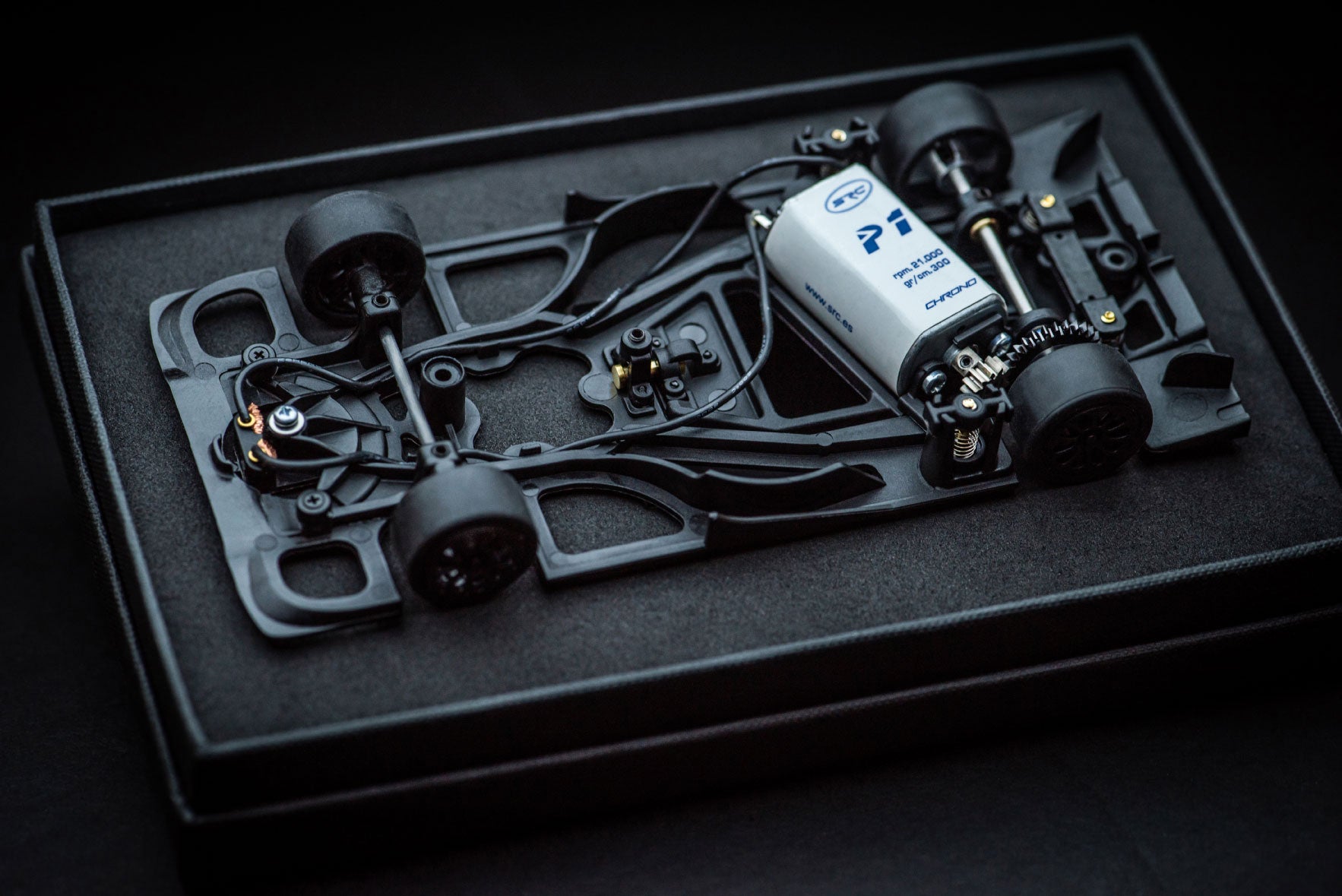


Commissioned by the SRC R&D department, we carried out a test of their shock absorber springs with the aim of getting up to date, understanding and organizing them at a theoretical level; and testing the sensations of assembly and driving at a practical level.
SRC currently has up to 12 different references of shock absorber springs, (dis)ordered in 4 series of 3, 3, 2 and 4 types with designations T1, T2, T3 and T4.
SRC SHOCK ABSORBER SPRING RANGE:
DOCKS T1 AND T2:
We have identified, pending confirmation from the manufacturer, that the T1 shock absorbers are the starting point for the entire range.
We also identified, also pending confirmation and thanks to seeing them equipped in 3 Chrono series cars, that the T1-Medium springs are the ones that are equipped as standard on both the front and rear axles.
(If this observation is the product of the undersigned's far-fetched imagination, we will consider it valid since it would be an ideal starting point).
Both T1 and T2 have three different types: soft, hard, and medium, providing three hardness levels depending on the wire used. The difference is that T1 is short (6mm) and T2 is long (7mm). This difference in length would result in different intermediate hardness levels between T1 and T2 when applied by stroke, not by wire.
Springs T1 and T2 ordered by hardness (lowest to highest) for practical purposes:
T2 soft < T1 soft < T2 medium < T1 medium < T2 hard < T1 hard

T3 SERIES
The T3 series represents the extremes, with 2 references including the ultra-soft T3BLT and the T Block S The closed-loop design, with only one turn of travel, means it locks the shock absorber with just a few tenths of a second of travel remaining. The T3s are the same length as the T1s.
T4 SERIES
The T4 series appears to be made from the same wire, and the difference between its four types is their overall length. Two distinctive features are that T4 springs have a tightly coiled center section and longer coils at the ends. Furthermore, their stiffness is inversely proportional to their length, with the shortest spring being the stiffest.
The T4.1 (5.2mm) springs have a single coil (turn) with travel at the ends and are the shortest in the series. The T4.2 (5.8mm) and T4.3 (6mm) are the two intermediate sizes, with two and three open coils, respectively, and a compact center. The T4.4 (6.2mm) springs have four coils, making them the longest and, paradoxically, the softest. For the same wire hardness, the strength of the T4 springs is inversely related to their designation and length: the T4.1 are the shortest and stiffest, while the T4.4 are the longest and have the greatest extension.
The first theoretical conclusion The entire series could be summarized in 5 references, the T1 and T3, since they show the tips and 3 intermediate levels of hardness:
T3BLT < T1 soft < T1 medium < T1 hard < T3 Block S
That's why I dare to propose to the brand a product "pack" with these 5 references grouped into one.
ORDER OF HARDNESS
SRC springs ordered by stiffness (lowest to highest stiffness) for practical purposes:
T3BLT < T2 soft < T1 soft < T2 medium < T1 medium < T2 hard < T4.4 < T1 hard < T4.3
Equivalencies for practical purposes:
The T3BLT would feel equivalent to the soft T2 with the damper head open 2 turns.
The soft T1 would be equivalent to the medium T2 as well, with the latter also having an open head.
The T2 duro and T4.4 have a similar feel and are difficult to distinguish. I consider them equivalent.
Similar to the previous ones, the hard T1 and the T4.3 feel similar to the touch.

WORKSHOP PRACTICE AND TRACK FEEL TEST:
GUIDELINES FOR THE TEST:
Four Lancia cars have been used S4 Chrono, two of them being (cars “B” and “C”) completely new ones assembled for the occasion and two that were already tuned and run (cars “A” and “D”).
AGRADECIMIENTOS.
We thank SRC for lending units “A” and “B” for the test, and also my fellow enthusiasts Mike Onane and Jordi Borromeo for lending their units. I must also thank Toni Mulet and Ròmul Puig for their contributions throughout the test period.
EQUIPMENT:
All four cars are equipped with the same motor (RM0109), the same short guide springs (RM0805), and the same hard rubber tires (RN0103), all new for the test. The RN0115 tires were discarded to avoid a tire with excessive grip and rapid wear masking the driving feel of the test. Four pairs of the same braid, cut to the same length, were also used, and the motor wires were replaced with four pairs of the same type. The bodies were adjusted to the same screw openings, and the motors were mounted to the chassis at the same height from the ground (1.2 mm). The front tire in all four cases is an ultra-profile, low-grip tire with a diameter close to 16.5 mm. The track widths of all four cars were adjusted to 61 mm at the rear and 56 mm at the front (rim to rim).
CARS “B” AND “C”
To reach a point of stable running and operation, the 2 new cars have been running a hundred (or thousand) stages for a month and a half, in their standard configuration, until they were considered sufficiently loose and matched in mileage, especially to the competition unit “A”.
Even with slight differences in character between them, cars “B” and “C” always maintained a similar behavior, leaving aside their initial stiffness to reach a point where starting to test springs was considered necessary.
The shock absorber configuration of cars “B” and “C” was, as we pointed out at the beginning of the text, T1 medium on both axles.
CARS “A” AND “D”
The two cars, already fine-tuned, had been running for about 3 months at the start of the test, were quite loose, and were used as extremes for the comparison.
One of these two cars, “A”, was configured with T3 Block S rear and T3BLT front, which is the extreme hardness configuration, proposed as ideal by most of the Legends championship specialists consulted.
Car “D” was assembled with the opposite end, soft T1 rear spring and medium T1 front spring, in order to compare the opposite end to the mantra of the “hard back soft front"that has haunted us since the Ninco era."
I must admit that the test could have been done perfectly well with cars “A” and “B”, but having two more units allowed me to always see the extremes (car “D”) or maintain the starting points as anchor (car “C”).

HOW THE TEST WAS PERFORMED
Car “B” was chosen to have the shock absorber changes performed, while car “C” retained its initial T1 medium setup on both axles for comparison. At the start of the test, car “B” was the most similar in feel and lap times to car “A,” which was considered the benchmark.
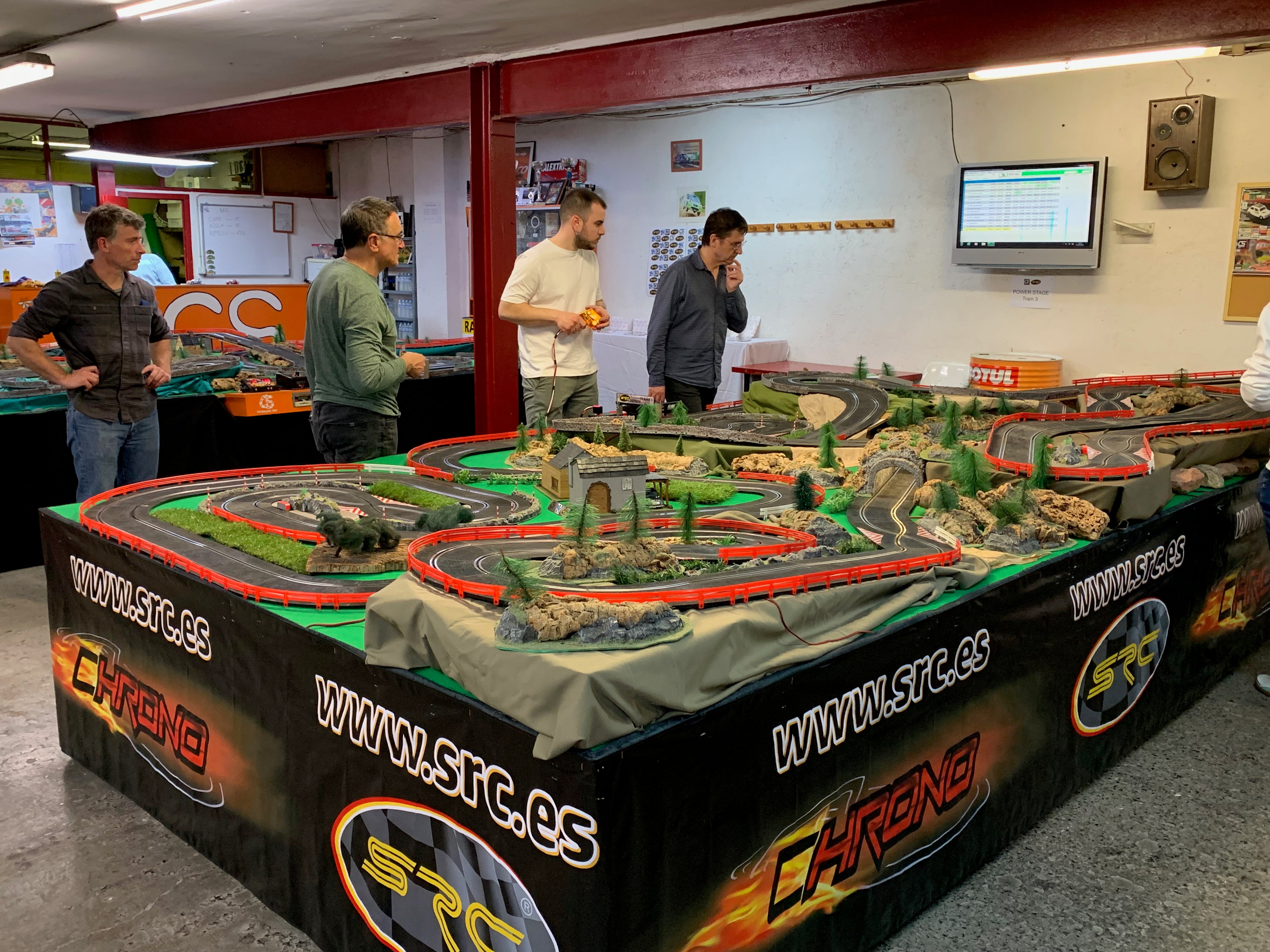
The six stages of a rally were used in Cerdanyola slot car racing, and their locations were kept secret at the start of the event. The four cars each completed one stage on the six stages, allowing for observation of their behavior and feel.
Each stage run was done with clean tires.
The tests for each car or configuration consisted of two runs on stages 1 and 2 in sporty driving, aiming to obtain a couple of times and noting sensations and observations:
ZERO TEST: Performed with unit “A”
ZERO BETA TEST: performed with the “D” unit without timing, only sensations.
TEST 1: Performed with units “B” and “C” with the original springs.
TESTS 2 to 6: The remaining tests were carried out with car “B” progressing through the spring changes. After each step by car “B” with its new configuration, cars “A” and “C” were run through to confirm the observations.

TEST RESULTS:
GENERALITIES (GENERAL CONCLUSIONS)
The lap times for all the configurations ended up being so similar that we decided not to include them, as they don't explain anything. The differences between configurations or cars are more about feel and confidence in the car, and no one configuration consistently shows worse times than the others.
I have always noticed this in SRC cars; in my fleet I currently have 5 active units, two Peugeots, two Lancias and a 914, and the times between the five cars differ by at most one second per stage.
“The stiffer the rear damper, the greater the need for counterweight”: with the initial setup, medium T1 on both axles, surprisingly the cars don't tend to roll over. Similarly, unit “D” with soft rear tires shows no sign of rolling over. Increasing the rear spring stiffness supposedly increases the leverage effect exerted by the body's volume on the outside wheel in the corner; the damper doesn't compress, and the car lifts.
"The frog jump": Contrary to the previous paragraph, and to my surprise, with soft rear shock absorbers, instead of tending to roll over, the car performs a lateral movement in the form of a half-flight (similar to the famous bullfighter's frog jump) upon entering a curve, before continuing its trajectory without further incident. This movement is heard as a "plop" upon entering the curve and usually occurs with very clean tires.
“Softer rear end, better braking”;
“Softer rear suspension, greater rollover absorption”;
“Softer rear end, better traction”…
These three conclusions determine the advantages of using soft or medium dampers on the rear axle. In other words, soft or medium rear dampers can work, and this must be considered in the car's setup. These three observations invalidate the mantra from the Ninco era.
“But a softer rear suspension = squarer corners.” The car slows down more in the corners. It's confirmed to be a setup issue. In this case, we corrected the excessive mechanical braking with a control adjustment.
“As we stiffen the rear and soften the front, the car becomes more inertial”: That is, it leans deeper into corners and brakes longer, maintains momentum better when releasing the throttle, and handles more like a 4x2 than a 4x4. This behavior is unrelated to the break-in or tuning of the cars, which is why so much time was dedicated to adapting the new cars. The cars were fully lubricated and tuned, and it was as we stiffened the rear suspension and softened the front that car “B” exhibited more inertial behavior than car “C” (which, remember, maintained the original T1 medium setup on both axles).
To rule out any variation in these general characteristics with the RN0115 competition tires, these were fitted to cars “A” and “B” at the end of the tests, resulting in the same sensations with an extra grip and a greater need for counterweights.
ZERO TEST
Car “A” / T3 Block S rear / T3BLT front / 4 side counterweight blades
The first test is done with the car configured according to the classic competition setup, and sensations and behaviors are noted.
The car moves forward on a flat track, with a smooth, progressive drift that's easy to drive and slide. The cornering speed is so high that the rear end tends to run wide.
In fast and linked sections, the speed constant is very high, even when entering areas with sharp braking too quickly.
The car handles more like a 4x2 than a 4x4.
Plenty of guide rail depth, perfect gearing, very long braking distance.
Due to the excessive skidding compared to the other cars, counterweights were removed, leaving 2 sheets on each side as a balance point to prevent the car from rolling over.

ZERO BETA TEST (performed one week before the joint test)
Car “D” / T1 soft rear / T1 medium front
Thanks to having a unit fitted with this unorthodox configuration (one of the three softest springs in the catalog at the rear) we took the opportunity to confirm or rule out that it was undrivable as is usually claimed.
The surprise was that at times car “D” was on par with the other three, and the following was discovered regarding its performance:
Enormous starting and traction capacity.
I take the corner by closing the car on the inside.
Not threats of turning around, but adaptability.
Excessive braking.
The movement of the rear gear, which causes the wheel axle to oscillate, does not affect (at least not noticeably) either noise or transmission failures. It's not mechanical perfection for a crown gear to move against a pinion, but this movement is imperceptible.
When accelerating out of a wide corner (drift exit), the car performs a kind of "trajectory correction," exhibiting a sort of "traction control" effect that corrects the excess power and straightens the car. In all cases, there is no counter-drift; that is, the car "self-corrects" when exiting the corner at full power. We also observed this effect consistently in cars "B" and "C," which are equipped with rear T1 mid-suspension suspension. In contrast, the rear-rigid unit "A" drifts and moves along a flat surface, maintaining a stable position.
We theoretically consider the setup with soft rear springs for possible low grip terrain or dirt rally.
TEST 1
Cars “B” and “C” / standard configuration / T1 mid rear and front.
This is the standard configuration; in lap times it performs on par with other cars, allowing us to assert that not having stiff rear shock absorbers is part of a car's setup.
No skidding. Excellent grip, good lane holding, with great traction and acceleration.
Better braking? Yes, high braking and starting capabilities.
Under laboratory asphalt conditions (flat and clean Ninco track) it is very safe, however in real conditions (dust on the track or secret section) it shows itself to be somewhat imprecise, or slow to react, or lacking in improvisation ability.
Instead of skidding, cars “B” and “C” do the “frog jump”.
The feeling that it doesn't let us get into the kitchen, doesn't let us turn around, as if it were driving too hard.
TEST 2
Car “B” / Rear T3BLT / Middle T1 Front
To corroborate the Zero Beta TEST, on the same day as the test we lowered the rear stiffness to the softest level in car “B”, which is the one chosen to make the changes.
We confirm that the soft rear spring end enhances the sensations of TEST 1.
Huge traction, possible dirt setting, better braking than with medium T1, more grip, more cornering power.

TEST 3
Car “B” / T2 hard rear / T1 medium front
Configuration with both spring types from the center of the SRC stiffness arc. Short rear travel and non-soft (but not-hard) front.
By stiffening the rear suspension slightly, the car brakes less and allows for better cornering, travels more on flat ground and at the same time begins to lift its leg slightly, especially in the first few laps with clean tires.
We began to consider the need for the counterweight mentioned earlier. It threatens to roll over due to the higher speed entering the curve.
It's curious that with just a slight increase in rear stiffness the car is so sensitive to changes.
Even so, the car still stalls at the entrance to the curve, and I'm afraid it's not so much due to the rear being medium/soft as it is to the front being medium/hard.
TEST 4
Car “B” / T2 hard rear / T1 soft front
We keep the rear suspension engaged and lower the front suspension by entering one of the 3 springs of the soft band.
The soft front T1, combined with a slight opening of the shock absorber head, maintains the sensations of TEST 3 and significantly reduces the rollover attempt. Could the corrected front stiffness be the cause of the rollover?
Even considering what was said in the previous paragraph, we still consider the need for a soft counterweight to ensure confidence in the car.
The car is even flatter but maintains high traction and a "square" cornering feel, perhaps due to the semi-hard rear suspension. It's faster than the setup used in TEST 3.
At this point, I go out on track with TEST 1 and TEST 0, cars “C” and “A” respectively: The superior grips and excessive braking of car “C” versus car “B” remain.
Car “B” from TEST 4 is similar in its design to car “A” from TEST Zero. The latter still has three counterweight plates on either side of the engine, making it more stable and secure, but slower to react and prone to drifting, perhaps due to the T3 Block engine. S rear or counterweight.
I confirm a direct relationship between rear rigidity and rollover tendency.
TEST 5
Car “B” / T4.2 rear / T1 soft rear and open shock absorber head
We configured it with less hardness at the front and greater hardness at the rear (one of the 3 hardest options).
The "traction control" effect discussed in the Zero Beta TEST (which was maintained in TEST 1 or with medium/soft rear shock absorbers) disappears and the car exits the curves flat.
The acceleration isn't as forceful and it maintains momentum entering corners much better. Braking distances are longer; in short, it maintains a more consistent speed.
Greater tendency to tip over, almost mandatory minimum 1 counterweight sheet per band.
TEST 6
Car “B” / T3 Block S rear / soft front
We increased the tendency of TESTS 4 and 5 to stiffen at the rear and soften at the front, and we have heightened sensations in the same direction.
The speed of entry into the curve increases, the speed constant increases, and the cornering speed is more lively.
Much longer braking distance and driving feel more like a 4x2 than a 4x4.
We understand that lowering the stiffness of the front spring and locking the rear reduces the importance of the front wheel contact on the track.
Attempt to tip over, I finally put weight 1 and 1 sheets (I didn't want to do it) and gain feelings of stability (more because of the guardrails than anything else).
I open the rear shock absorber head a little to have a minimum amount of survival travel.
With this latest configuration and with counterweights already in place, car “B”, which initially behaved similarly to car “C”, now resembles car “A”.
---------------------------------------------------